
Genuine Apple MacBook chargers cost around £60–£80, which is why many owners end up using cheaper alternatives. If that’s you, you likely fall into one of two groups:
- You knowingly bought a non-genuine charger and saved up to £60
- You don’t realise your charger isn’t genuine
If you’re in the second group, it’s worth checking — now.
How to Identify a Genuine Apple Charger
A real Apple charger will include both of the following:
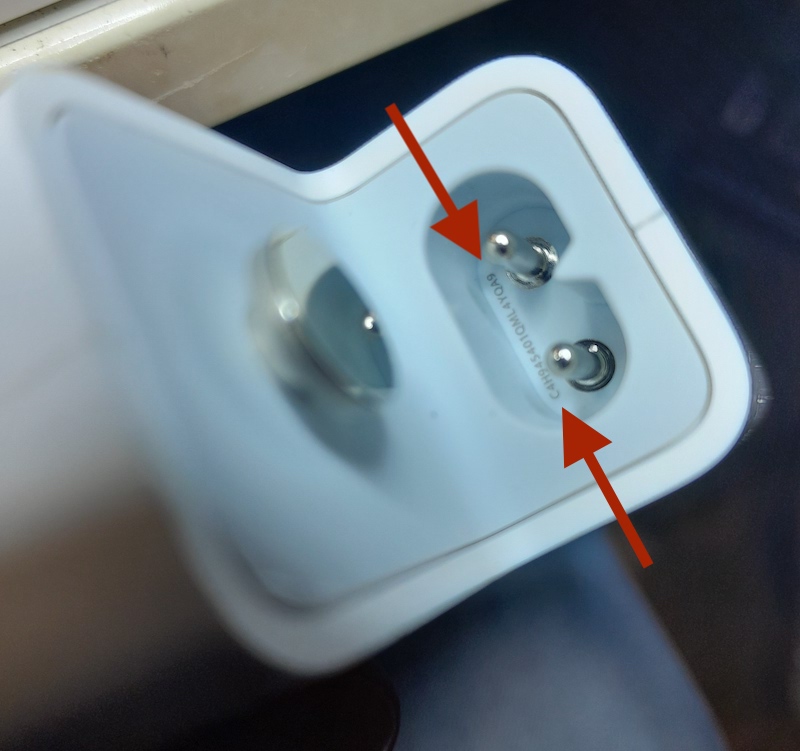
A serial number near the mains connection (you may need to remove the country-specific plug head to see it)
The phrase “Designed by Apple in California” clearly printed
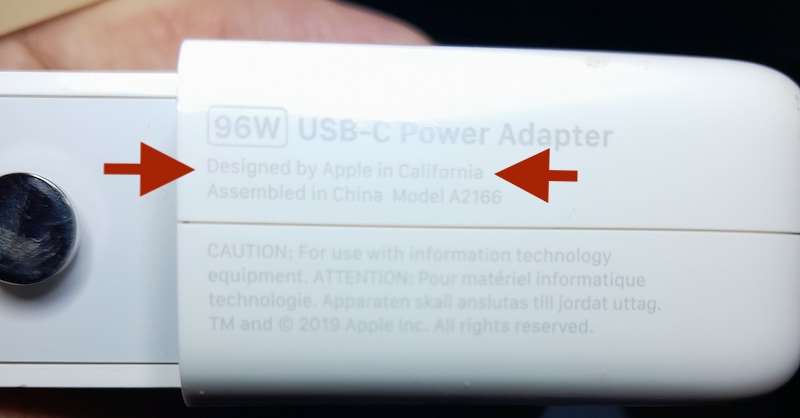
If your charger lacks these markings, it is not an Apple charger — regardless of what the seller claimed. Dispose of it now. If funds dont allow purchase of a new genuine charger buy a used genuine charger.
Genuine Apple chargers are solid, well-finished, heavy and, yes, reassuringly expensive. Look-alikes fall short in every respect.
You dont need an expensive USB charger lead – an Amazon basics £5 lead is fine – what is vital is that it is undamaged.
Why This Matters More Than You Think
Many people assume the charger only connects to the battery. It doesn’t.
The charger connects to your MacBook’s logic board, which first communicates with the charger, verifies it and then requests the correct voltage. This process relies on properly designed electronics inside the charger.
Cheap or fake or compatible chargers are built to look real but cut every possible corner on safety:
- Poor-quality and simplified circuit designs
- Inadequate or non-existent filtering giving no protection from mains voltage spikes and surges
- Ignoring “creepage distance” requirements — physical gaps inside the charger that separates the high-voltage parts from the low voltage parts you touch. In a fake charger, this gap can be so small that the 240V from your wall can arc or “jump” directly to the 5V side
The result? Those spikes could travel straight into the logic board, damaging it and requiring a logic board repair or if you believe Apple – logic board replacement.
The Real Cost of a “Cheap” Charger
A fake look-alike or compatible charger may power your MacBook today.
What it may also do is instantly destroy it tomorrow.
I see the consequences regularly: logic boards damaged by low-quality chargers that saved a few pounds upfront but caused hundreds in repairs.
If your charger didn’t come directly from Apple take a moment to check it.
That £60 saving could cost you far more.
p.s. it is safe to power your MacBook from a battery power bank that supports Power Delivery (PD) protocol (e.g. Ugreen, Anker) – as there are no mains power spikes involved. I would also trust mains chargers from well known good manufactures (e.g. Dell, Lenovo, HP).