
Choosing the Wrong MacBook Repairer
When your MacBook won’t power on or starts behaving unpredictably, who you trust to repair it is critical. MacBooks are not general consumer electronics — they are densely engineered, highly integrated computers. Choosing the wrong repairer can cost you money, data and the chance of a successful repair.
MacBook repair is a specialist job.
1. Apple
Apple does not provide a component-level repair service. They do not operate electronic repair workshops, nor do their technicians perform fault diagnosis at circuit level. Instead, Apple’s repair model is based on large-scale part replacement and the cost of those parts is extremely high.
If you visit Apple hoping for a warranty repair, be aware that they commonly look for any indication of liquid ingress. Even minor, inconsequential signs — often caused by everyday humidity, dust or natural environmental exposure — can be enough for Apple to void a warranty claim.
MacBooks can and often do continue to operate normally despite low levels of visible corrosion. However, Apple may still use this as justification to refuse warranty coverage, even when the actual fault is unrelated, such as a failed component or manufacturing defect.
Once liquid damage is declared your warranty is voided and Apple’s standard response is to quote for replacement of the logic board, keyboard and trackpad — effectively replacing nearly all of the electronics. The cost is typically close to that of a new MacBook, which strongly encourages customers to abandon repair altogether and purchase a replacement. The original machine is then conveniently “recycled” and removed from circulation.
It’s important to remember: you already paid a premium for your MacBook and usually only one component has failed. The solution is not wholesale replacement — it’s accurate diagnosis by a trained specialist and an appropriate targeted repair.
Apple technicians do not remove and inspect logic boards at component level. Declaring that “the logic board must be replaced” is not the same as diagnosing a fault — it reflects the limits of Apple’s repair model, not the true repairability of the machine.
2. Computer, Phone & Vape Shops
(easily recognizable because they claim they fix all types of laptops & PCs)
⚠️ Warning: While these shops may competently replace phone screens or batteries, they are not suitable for repairing a dead MacBook. MacBook logic boards require specialist tools, knowledge and experience. In the wrong hands, they are easily damaged beyond economical repair.
A common and costly outcome is that incorrect repairs introduce new faults, masking the original problem and making proper diagnosis far more difficult and frequently making repair of a logic board impossible.
One customer brought her MacBook to me after a high-street Computer, Phone & Vape shop had attempted a repair, failed and still charged her a small fee. When she arrived, she handed over the MacBook along with a small bag containing two CD3217 chips the shop had replaced.

The CD3217 is a 6mm x 6mm Texas Instruments ball grid array chip (BGA) that sits behind each MacBook USB port. It is responsible for power delivery (PD) and data communication and interfaces with whatever you plug into its associated USB port (e.g. flash drive, video, audio, charger). It has 96 solder balls that, when fitted correctly, connect it with 96 pads on the logic board. CD3215 pictured.
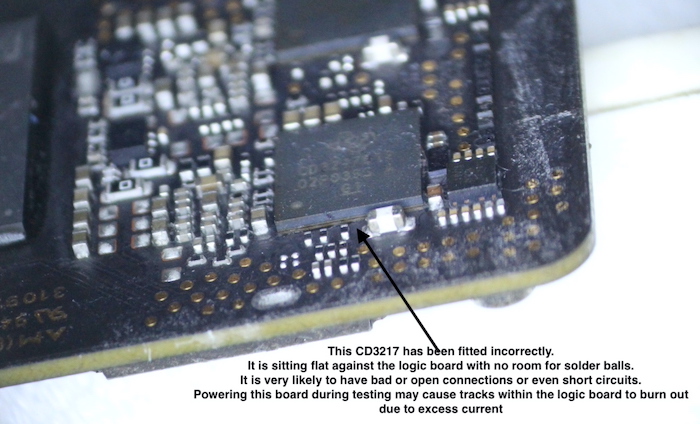
On inspection, it was immediately clear that the chips had been installed incorrectly — soldered flush to the board with no allowance for proper solder ball spacing. This virtually guarantees short circuits between the 96 connectors. The installation showed a lack of understanding of MacBook board architecture and BGA soldering techniques.
A MacBook logic board contains multiple internal layers with dozens of microscopic tracks. If even one of these tracks is damaged — something that happens easily during improper soldering — the MacBook will not power on. Repairing internal track damage is extremely difficult and sometimes impossible.
Unfortunately, the attempt by a non-specialist sealed the fate of this logic board. The only remaining option was a replacement Apple logic board — which we were at least able to supply at significantly less than Apple’s price.
This CD3217 has been fitted incorrectly by a high street computer shop. It is sitting flat against the logic board with no rooms for solder balls. It is very likely to have several shorted connections amongst the 96 connections. Powering this logic board would almost certainly cause burn out of tracks within the logic board which are impossible to repair due to their density. The logic board is now effectively unrepairable.
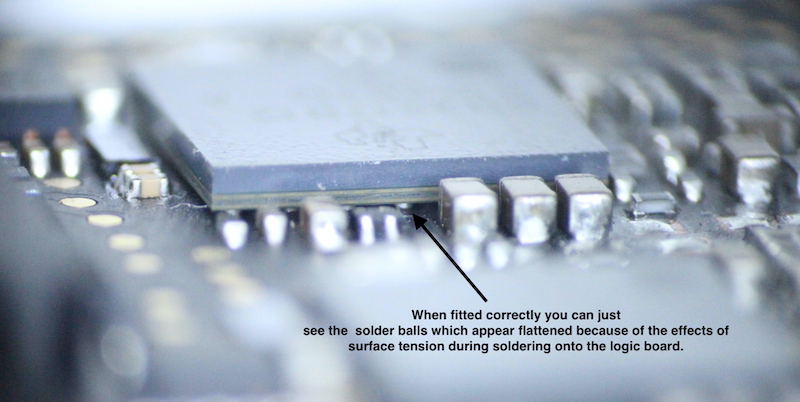
When fitted correctly you can just see the neatly spaced solder balls underneath the chip.
The Bottom Line
MacBook repair is not general electronics repair. It requires detailed electronic knowledge, specialist equipment and real-world experience with Apple logic boards. Choosing the wrong repairer can turn a repairable fault into a total loss.
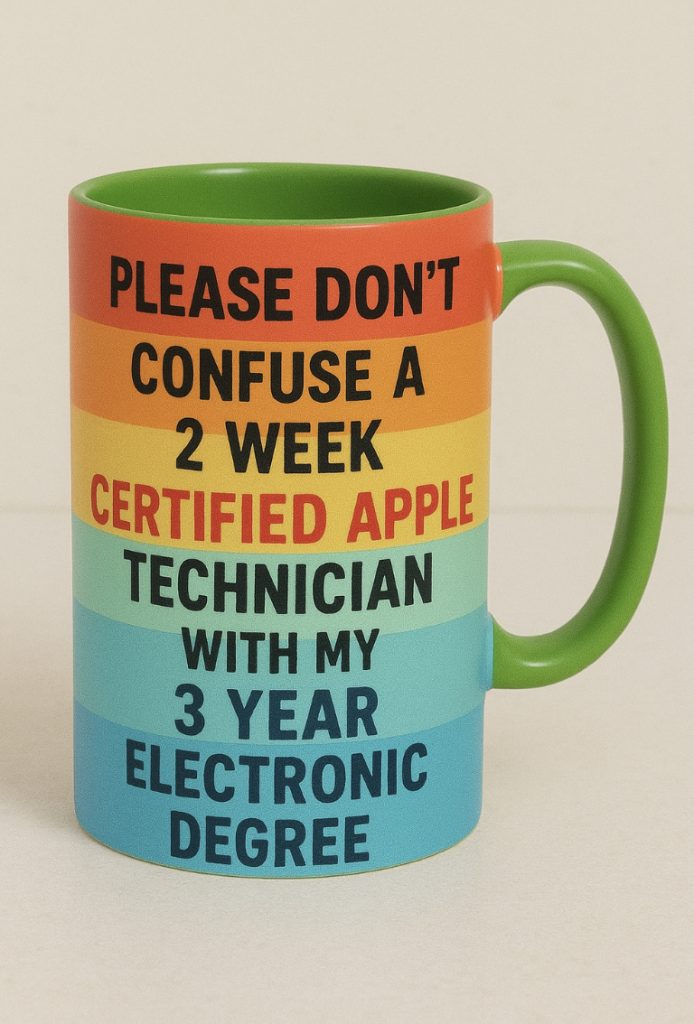
If your MacBook matters to you, trust it only to a qualified electronic engineer and MacBook repair specialist.